
Hydraulic and hydrological invariance
The study and certification showing that a change in land use does not increase the peak flow discharged downstream.
The principle
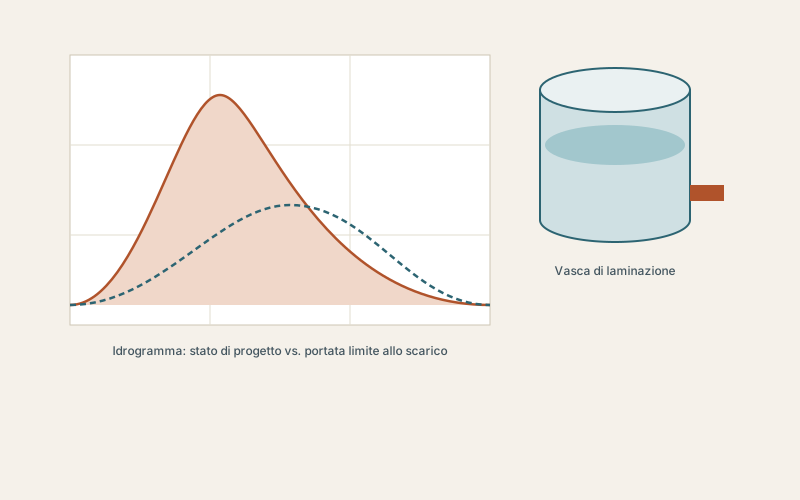
Hydraulic invariance requires that the maximum flow discharged from the area after the works does not exceed the pre-existing one; hydrological invariance extends the constraint to the total volume discharged. In practice, the sealing of the ground caused by buildings, yards and roads is compensated by devices that retain and gradually release stormwater.
When it is mandatory in Lombardy
The reference is Regional Regulation of 23 November 2017, no. 7 (and later amendments, including R.R. 8/2019), implementing art. 7 of Regional Law 4/2016. An invariance study is generally required for:
- new buildings and extensions that increase the impermeable surface;
- urban redevelopment works and new urbanisation;
- implementation plans and conventioned building permits;
- roads and yards.
The extent of the requirements depends on the intervention class (according to the area affected) and on the territorial area to which the municipality belongs, classified by hydraulic criticality (A – high, B – medium, C – low).
What it includes
Hydrological analysis
Definition of the rainfall depth-duration-frequency curves for the municipality, choice of the return period and of the design parameters.
Flow-rate calculation
Estimation of the flow generated by the area in the existing and design states using the kinematic or storage method, as a function of runoff coefficients.
Attenuation volume
Sizing of the storage volume needed to comply with the maximum permitted discharge flow (indicatively 10–20 l/s per hectare depending on the area).
Invariance devices
Design of detention tanks, drainage trenches, soakaways (where permitted) and infiltration systems, with an outlet flow-regulation structure.
Infiltration check
In-situ permeability tests and check of water-table depth to establish whether disposal into the subsoil is feasible.
Report and certification
Technical report, design drawings and professional certification to be attached to the building application and sent to the competent body.
Discharge hierarchy
The Regulation requires giving priority, in order, to:
- reuse of stormwater (irrigation, non-potable uses);
- infiltration into the soil and subsoil;
- discharge into a surface watercourse, with regulated flow;
- discharge into the sewer, as a last option and subject to agreement with the operator.
Procedure
- Check of the obligation and of the intervention class according to the municipality and the surface area.
- Site visit, permeability tests and collection of design data.
- Hydrological-hydraulic calculations and sizing of the devices.
- Drafting of the report, drawings and certification.
- Filing with the building application and submission to the competent body / operator of the watercourse network or sewer.
Note. Limit flow values, return periods and area thresholds are set by the Regional Regulation in force and may be further specified by municipal or operator regulations. Each study is tailored to the municipality and to the territorial area of the site.
For works located in other regions, the respective regulations on hydraulic and hydrological invariance apply, with similar calculation and sizing criteria.
Do you need to submit a hydraulic invariance study?
Tell me the municipality, plot area and type of works: I will check the obligation and send you a quote.